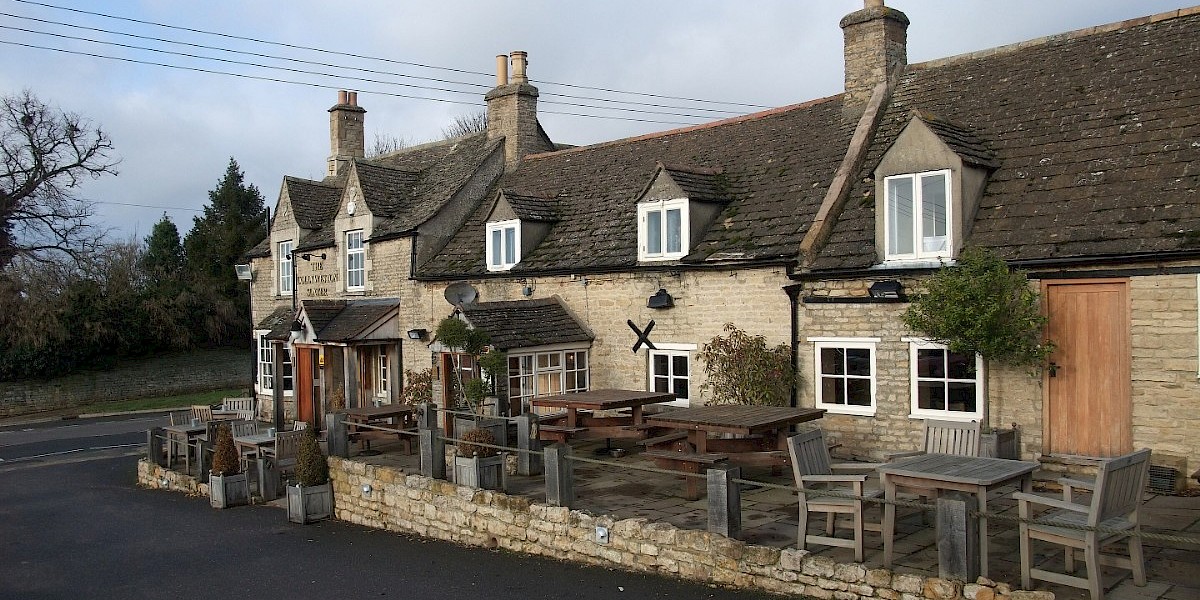
Perched on a wedge of Jurassic limestone three miles west of Stamford, Collyweston tilts gently toward the River Welland, its honey-coloured cottages and slate-topped gables catching every drop of afternoon sun. Those roofs are village calling cards: thin, blue-grey “Collyweston slates” once prized from frost-split limestone, carted by barge to Cambridge colleges and London townhouses, and still clinking beneath the boots of present-day slaters who guard the craft like a secret recipe. A single street curves past low walls tufted with valerian, then pauses beside St Andrew’s church, where a medieval tower and 15th-century nave cradle carved bench-ends and the soft tick of a centuries-old clock.
Just beyond the lychgate, history takes an unexpectedly regal turn. Here in the 1490s Lady Margaret Beaufort, mother of Henry VII, built a grand manor, its gardens said to rival Hampton Court; only grassy humps and a scatter of carved fragments remain, yet residents still speak of “the palace” as though the grey-gowned Lady might return at any moment to survey her park. Today the social throne has passed to the Collyweston Slater, a flagstoned inn with beams as crooked as its nickname. Locals swap Welland-valley gossip over pints of Rutland ale while cyclists refuel on doorstep sandwiches before tackling the short, sharp climb of Kettering Road.
Leave the pub and follow Church Walk past allotments buzzing with bees and you meet the edge of Collyweston Great Wood, one of the largest surviving tracts of ancient limestone woodland in England. In April the rides glow with primroses and oxlips; by midsummer, silver-washed fritillaries dance above dog’s-mercury, and the shade smells of warm honey and leaf-mould. Way-marked paths link to the Jurassic Way long-distance trail, threading oak-lined hedgerows toward Wakerley or dipping to the Welland for kingfisher flashes and lazy back-eddy picnics.
Despite its modest footprint, barely 600 residents, Collyweston feels lively. Church bells practice on Tuesday evenings, garden-gate plant stalls appear in June, and every Boxing Day the village turns out for the traditional tug-of-war across the green. At dusk cottage windows wink to life and the last rooks settle in palace-gate beeches, while the floodlit spire of St Andrew’s stands sentinel over rooftops laid, quite literally, with local history. For travellers seeking England in miniature—craft heritage, royal intrigue, and countryside that begins at the back door, Collyweston offers a quietly unforgettable pause between the bustle of Stamford and the wide horizons of the Welland Valley.