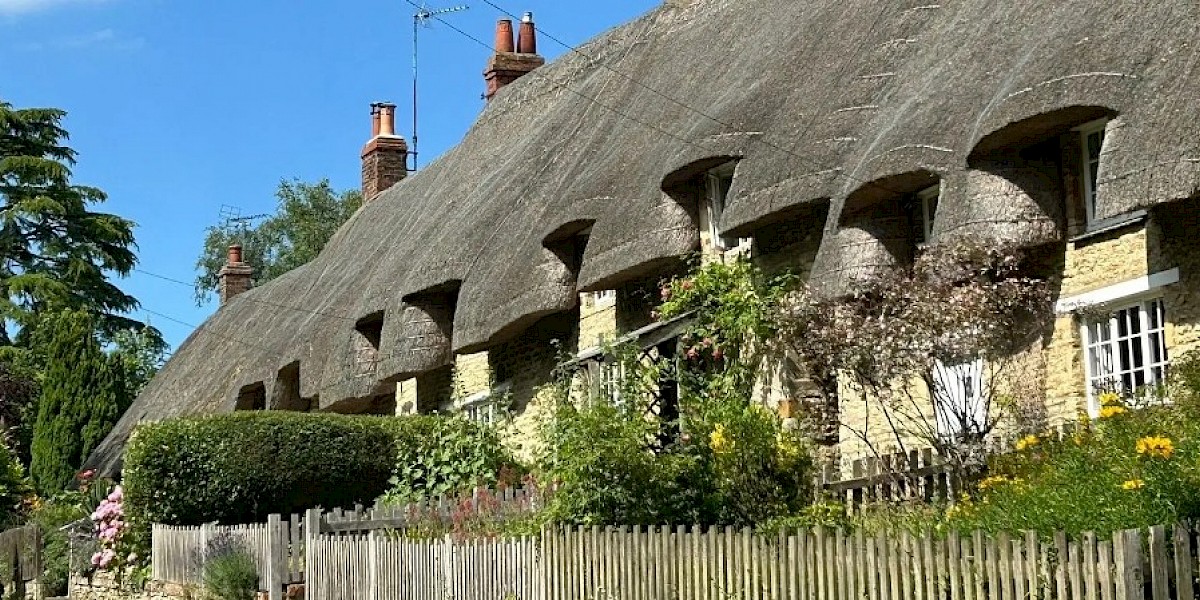
Tucked away in the dove-grey limestone country of north-east Northamptonshire, Cranford St Andrew lies barely three-and-a-half miles south-east of Kettering—close enough to glimpse the spire of the market town on a clear day, yet far enough to feel as secluded as any back-lane hamlet. A quick slip from the A14 brings you onto winding lanes edged with cow-parsley and stone walls, and almost before you realise it you are coasting past thatched cottages, pocket orchards and a village green that still hosts summer fêtes and pop-up produce stalls.
The settlement’s story is written in its name: “craneford” recalls a marshy crossing where herons once picked their way across the River Cran, while the dedication to St Andrew distinguishes it from neighbouring Cranford St John. Though the Domesday Book lumps the two together, separate manors were recorded by 1254, and in the early Georgian era the Robinson baronets unified the estates—one reason the landscape still reads like a single park dotted with farmsteads, long-hedged paddocks and venerable oaks.
At the heart of the scene stands St Andrew’s Church, its 12th-century Norman arcade glowing honey-gold in late-afternoon light. Open daily, the Grade II* building rewards unhurried exploration: medieval glass glints in the east window, an exquisitely carved Flemish pulpit panel peeks from Victorian woodwork, and ringers practising on the 17th-century bells provide an atmospheric soundtrack on Thursday evenings. Step outside and you find yourself in the parkland of Cranford Hall, where a cedar of Lebanon frames story-book views across sheep-dotted meadow to the sister church of St John.
Cranford Hall itself, a mellow-stone Georgian mansion still lived-in by the Robinson family, is not a stately-home museum but a working estate that occasionally opens its gardens for weddings, charity events and heritage weekends. A walled kitchen garden, Tudor-Bethan stable block and riverside pleasure grounds stitched together by the Jubilee Bridge offer glimpses of gentry life, while the squeal of swallows under the eaves reminds visitors that this is very much a lived-in, lovingly tended place.
Village life today turns around a handful of cottages and the award-winning Red Lion, where modern British menus spotlight Northants venison, estate-grown asparagus and pints of locally brewed Rockingham Ale. On Friday evenings walkers drift in still booted and muddy from the lanes, cyclists lean their bikes against the honey-stone wall, and the low-beamed snug hums with talk of cricket fixtures and harvest weather.
Beyond the last cottage gate the countryside opens into Twywell Hills & Dales, a reclaimed ironstone landscape now quilted with wildflower grassland and way-marked trails. The easy Cranford Circular picks up old quarry tracks—still scarred in places by rust-red rock faces—while a longer loop climbs to breezy viewpoints where you can trace the sinuous Ise Valley and, on a good day, spot the towers of five county churches. The ironstone story gives the walk a dash of industrial drama; the birdsong and clouds of chalkhill blues supply the serenity. It is this blend of working-landscape grit and timeless rural charm that makes Cranford St Andrew such a rewarding little corner to linger in, whether you are pausing for an hour or settling down for a slow weekend.