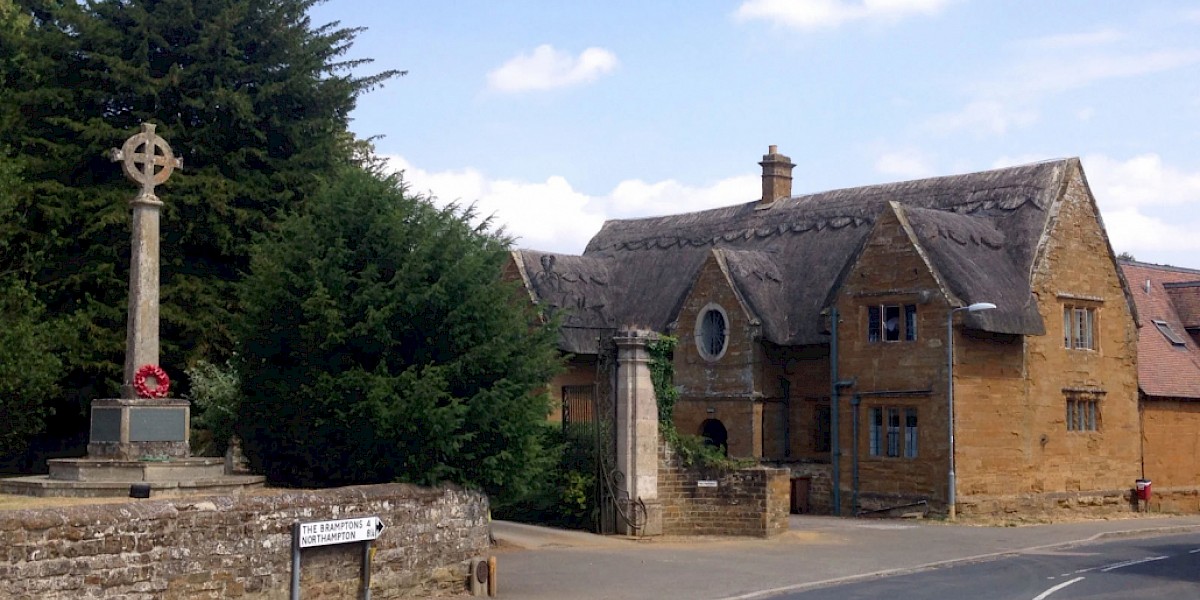
East Haddon lies in the West Northamptonshire countryside, about seven miles north-west of Northampton, and sits on elevated ground with views over the surrounding farmland.
The village is approached by narrow lanes and is characterised by traditional limestone houses, many dating from the 17th and 18th centuries, alongside more recent developments that have kept to its established style. The settlement is recorded in the Domesday Book of 1086 as “Hadone,” and its name is thought to mean “hill spur hill,” reflecting the topography.
The parish church, dedicated to St Mary, stands at the heart of the village. Parts of the current structure date to the 13th century, with later additions in the 14th and 15th centuries. It has a prominent west tower and spire, a nave with north and south aisles, and several memorials to local families. The churchyard contains mature yews and offers views over the surrounding countryside.
East Haddon retains several amenities for its size, including a primary school, a village hall, and The Red Lion public house. The school occupies a Victorian building that has been adapted for modern use, while the village hall hosts social events and community groups. There is a sports field on the edge of the village, supporting cricket, football and other activities, and a network of public footpaths links East Haddon to neighbouring settlements and the wider countryside.
The village lies close to two of Northamptonshire’s most notable historic estates. To the south-east is Holdenby House, built in the late 16th century for Sir Christopher Hatton and later a royal palace, now a privately owned home with gardens open to visitors at certain times. A short distance to the south is Althorp, the ancestral seat of the Spencer family, with its stately house, extensive parkland, and museum displays. These estates, together with East Haddon’s own heritage and conservation status, root the village firmly in the county’s historic landscape while keeping it within easy reach of modern transport links via the A428 and M1.
The local economy has historically been based on agriculture, and while many residents now commute to nearby towns, the surrounding land remains in productive farming use. The village falls within a conservation area, helping preserve its architectural character and open spaces. This combination of historical continuity, community amenities, and scenic surroundings makes East Haddon a representative example of Northamptonshire’s smaller rural parishes.