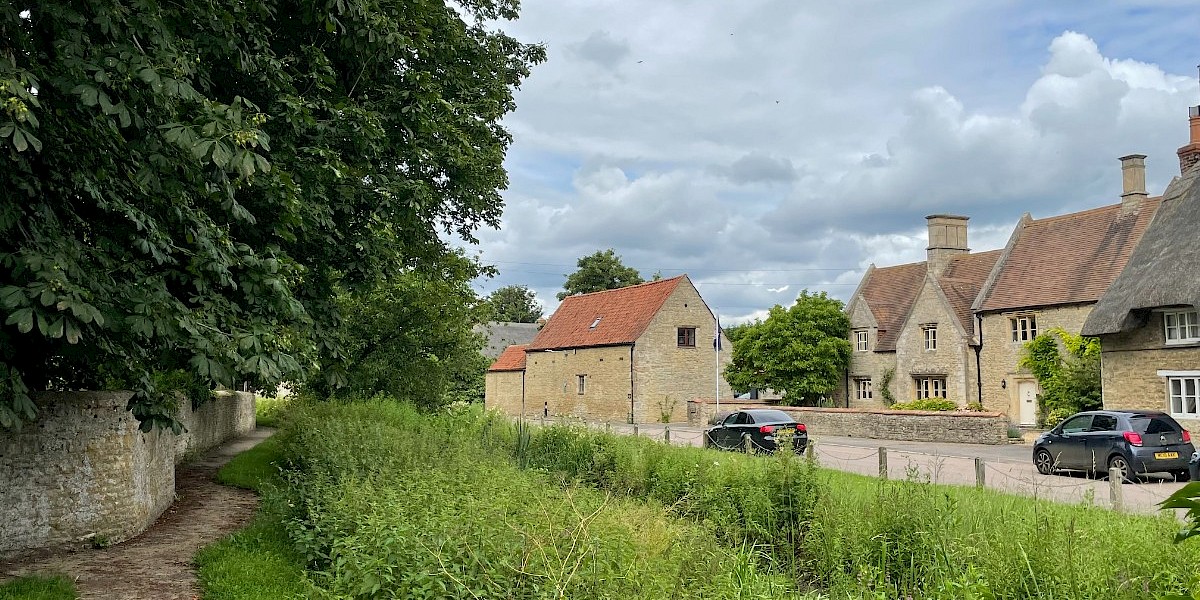
Grafton Underwood rests within the softly rolling countryside to the east of Kettering, where lanes meander between farmland and remnants of ancient woodland. The name reflects its origins, with ‘Grafton’ denoting a settlement by a grove and ‘Underwood’ a reminder of its close ties to Rockingham Forest, once a vast royal hunting ground. Approaching the village, one encounters mellow ironstone cottages with thatched and slate roofs clustered around greens and lanes that speak of long continuity.
The Church of St James the Apostle is the village’s architectural and spiritual centre. Its slender spire rises above the rooftops, visible across the surrounding valley, and inside are monuments that chart the history of local families over many centuries. The building itself retains fine medieval stonework, while the churchyard with its ancient yews provides a tranquil setting, reinforcing the sense of a place long rooted in faith and tradition.
History here is layered and varied. Rural life for much of the village’s existence revolved around farming and the management of the nearby forest, which provided both sustenance and employment. The pattern of farmhouses, barns and cottages still hints at these origins, even as some have been adapted for modern living. Landownership, too, left its mark, with the nearby estates shaping the fortunes of Grafton Underwood and influencing its built character.
The Second World War brought dramatic change when Grafton Underwood became home to a United States Army Air Forces base. Station 106, as it was designated, was one of the first bases used by the American Eighth Air Force in Britain. Heavy bombers flew from here on missions over occupied Europe, and the airfield bustled with activity that contrasted sharply with the village’s quiet rural life. Though the runways are long disused and the land has largely returned to agriculture, memorials and recollections preserve the memory of those years and the deep connections forged between villagers and airmen.
The village also enjoys a cultural resonance, featuring in Alan Sillitoe’s novel “Saturday Night and Sunday Morning,” and its wider landscape has inspired many who have walked its lanes and paths. Today, Grafton Underwood remains a close-knit community where heritage is cherished. Seasonal gatherings, local initiatives and the quiet rhythm of rural life provide continuity, while nearby Kettering offers broader services.