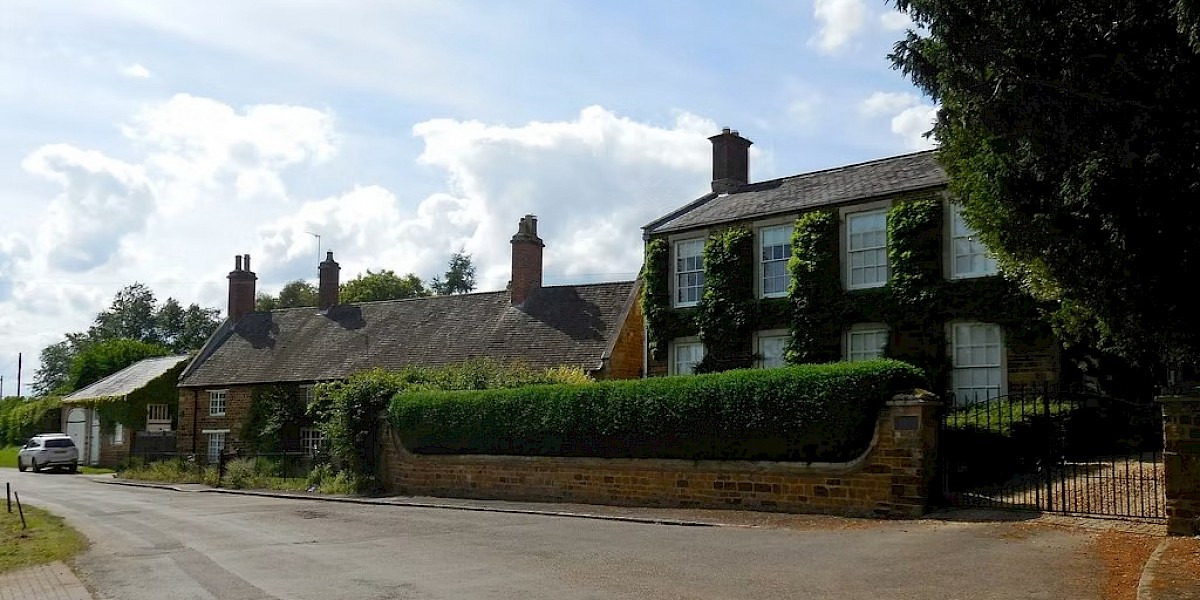
Great Cransley is a rural village in northern Northamptonshire, lying among gentle farmland and hedgerows between Kettering and Broughton. The setting is peaceful, with winding lanes leading through fields that still reflect the area’s agricultural traditions, while views open out towards the rolling ridges of the Nene Valley. It has long been a settlement shaped by its landscape, with evidence of medieval ridge and furrow patterns still discernible in the surrounding countryside.
The name Cransley is thought to derive from Old English, possibly meaning ‘clearing of the cranes or herons’, reflecting either the birds once found near local waters or the association with a personal name. Great Cransley and its neighbour Little Cransley are distinct, with the former always having been the larger and more prominent community. The manor here was for centuries linked to important local families, with records showing the Catesbys and later other gentry holding land.
At the centre of the village stands the church of St Andrew, its tower and stonework demonstrating centuries of worship and continuity. The building contains elements from the Norman period onwards, and like many Northamptonshire churches it was enlarged and refined in the later medieval period. It remains a focus for village life, alongside a modest scattering of homes and farms built in local ironstone. The churchyard, with its timeworn memorials, adds a sense of history and rootedness.
Though Great Cransley today has few amenities compared to larger settlements, it retains a strong sense of community. Traditional gatherings, fundraising events and church services help sustain local ties. Residents also make use of facilities in nearby Kettering, just a short distance away, which provides the conveniences of town life while leaving the village atmosphere unspoiled.
The landscape around Great Cransley is rich with walks and bridleways, ideal for those exploring on foot or horseback. Seasonal changes bring colour to the hedgerows, and the patchwork of pasture and arable land has scarcely altered in character for generations. This enduring connection between land, people and history is what makes Great Cransley a distinctive and appealing corner of Northamptonshire.