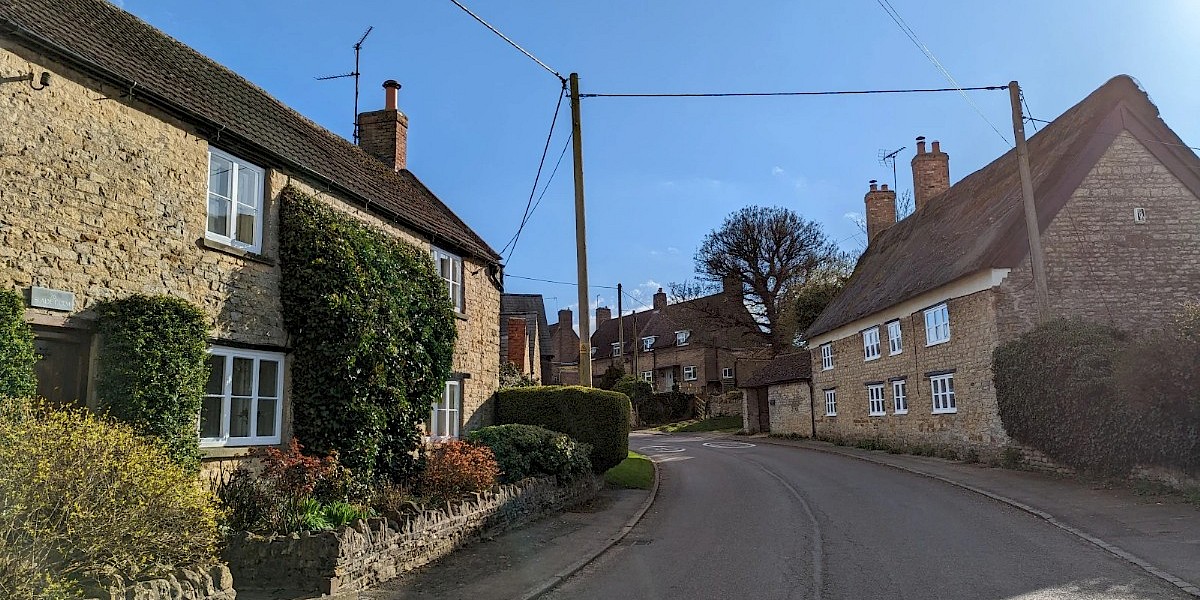
Harrington is a small Northamptonshire village set among gently rolling countryside between Rothwell and Market Harborough, close to the county’s northern boundary with Leicestershire. The settlement sits amid farmland and quiet lanes that reflect the long agricultural history of this part of the Welland valley landscape. Its name is thought to derive from Old English, meaning the farm or settlement of the people of Hæra or Hæring, hinting at early Saxon origins and a community rooted in the land for well over a millennium.
At the heart of the village stands the Church of St Peter and St Paul, a stone building whose fabric spans several centuries and reflects the slow evolution of the parish. The church, with its tower and traditional Northamptonshire limestone construction, forms a focal point for the village and is surrounded by cottages and farmhouses that preserve the rural character of Harrington. Many of the buildings display the warm honey-coloured stone typical of the region, giving the settlement a sense of architectural continuity with the surrounding countryside.
Historically Harrington developed as a small farming community, its fields divided between arable land and pasture. The wider area was shaped by medieval agricultural practices, later evolving through the enclosure of fields and the improvements of estate farming. Nearby country houses and estates, including Lamport Hall a short distance to the south, influenced the local economy and landscape, bringing employment and shaping land ownership patterns across the parish.
A distinctive chapter in Harrington’s history came during the Second World War, when the nearby RAF Harrington airfield was constructed. The base became an important centre for covert operations, particularly those connected with the “Carpetbagger” missions that supplied resistance groups in occupied Europe. Today the Harrington Aviation Museum preserves this remarkable story, with surviving structures, exhibits, and memorials that recall the secret flights and the international effort that once centred on this quiet rural area.
The village’s rural setting continues to define everyday life. Footpaths and bridleways cross the surrounding fields and connect Harrington with neighbouring villages, offering views across open countryside typical of northern Northamptonshire. The nearby former railway line between Northampton and Market Harborough, once served by Lamport and Harrington station, is another reminder of the area’s changing transport links and the role the railway once played in connecting rural communities.
Despite its modest size, Harrington retains a strong sense of place shaped by history, landscape, and community life. The church, historic farm buildings, and wartime heritage together create a village that reflects many layers of Northamptonshire’s past, while its peaceful lanes and surrounding fields maintain the enduring atmosphere of an English rural parish.