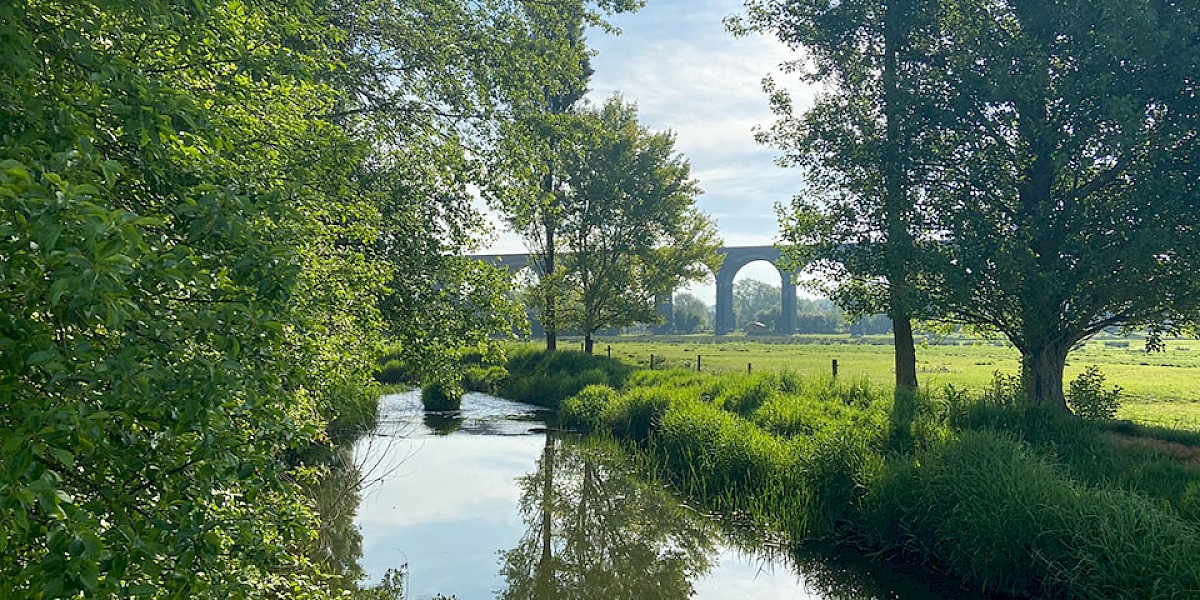
Harringworth has one of the most dramatic settings of any Northamptonshire village. Set in the Welland Valley on the county’s northern edge, close to Rutland, it is a place of meadows, river views and wide skies, but it is the great Welland Viaduct that fixes itself in the memory. Sweeping across the valley on 82 arches, this vast Victorian structure remains the longest masonry viaduct across a valley in the United Kingdom, and it gives the village an unmistakable sense of scale and character.
That striking railway landmark can sometimes overshadow the older Harringworth beneath it, yet the village has deep medieval roots. It was an important settlement by the time of Domesday, and in the Middle Ages it was associated with the de Cantilupe and later la Zouche families. The manor here was once substantial enough to include a great hall, chamber, kitchen, stable and chapel, and traces of that long manorial story still survive in the village fabric.
The parish church of St John the Baptist is central to Harringworth’s historic identity. Grade I listed, it stands just behind the main street and combines a 12th-century tower with a 14th-century spire, while its stonework and proportions give it the quiet authority of a church that has watched over the valley for centuries. Seen with the viaduct nearby, it creates one of those rare Northamptonshire scenes in which medieval and industrial landmarks sit side by side, each sharpening the effect of the other.
Away from the headline views, Harringworth rewards slower attention. Listed buildings such as the Manor House and Manor Cottages hint at the village’s long architectural evolution, with medieval and later work surviving in stone and slate. The lanes and houses have the settled feel of a place shaped over many generations rather than remade in a single period, and the surrounding countryside draws walkers, cyclists and railway enthusiasts who come for both the landscape and the famous crossing above it.
Community life remains an important part of the village’s appeal. The church, village hall, local clubs and riding stables all help to give Harringworth a lively rural identity, and its position near Uppingham, Oakham and Stamford makes it feel connected without losing its own distinct atmosphere. For visitors, it is a village of contrasts in the best sense: intimate yet expansive, deeply historic yet defined by one of the boldest pieces of nineteenth-century engineering in the country.